
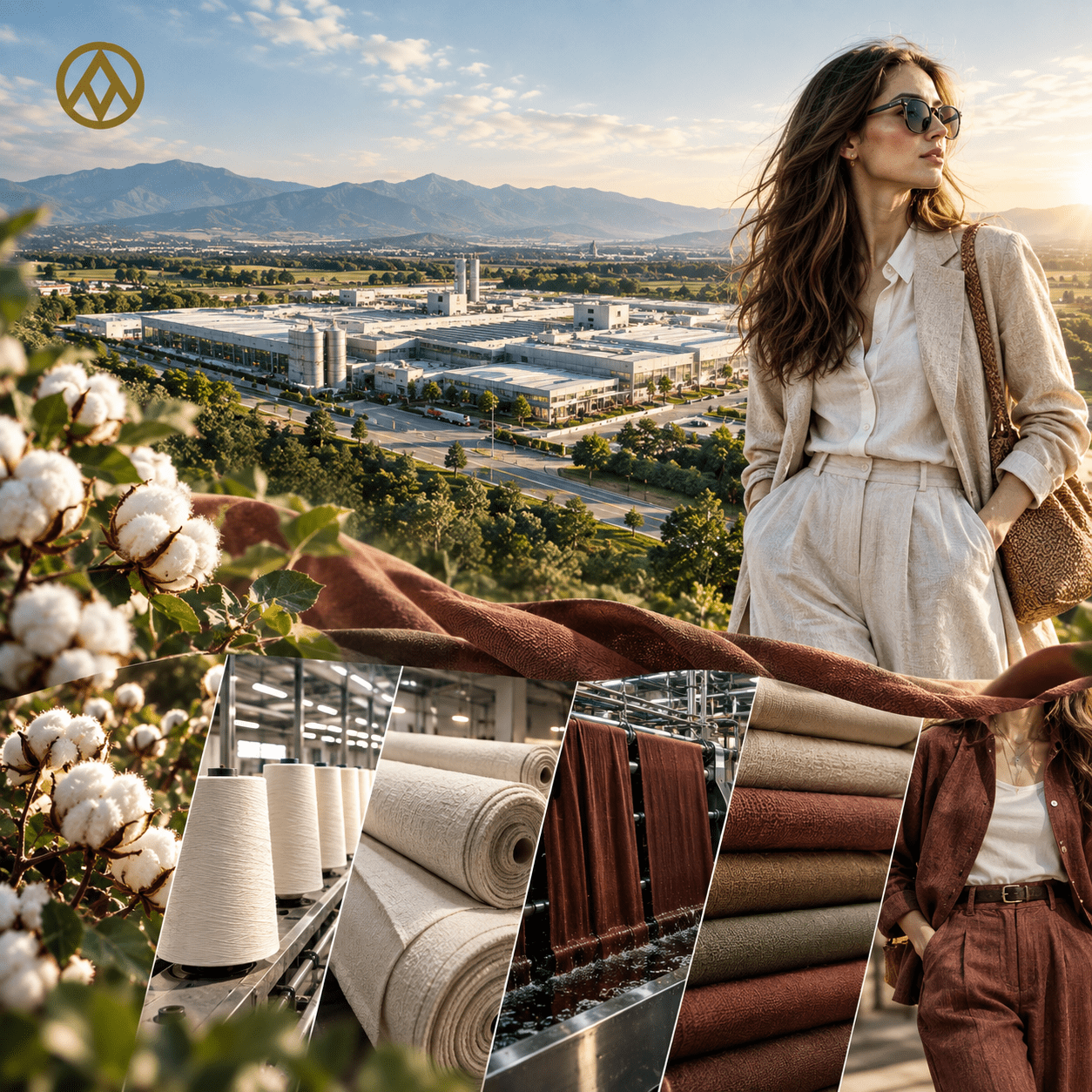
What is integrated textile production?
Integrated textile production refers to executing the different production stages of a textile product in a coordinated manner within the same manufacturing organization.
When stages such as yarn production, knitting, and dyeing are considered independently of one another, process management can become more complex.
An integrated structure, on the other hand, can ensure coordination across various stages of production.
From yarn production to fabric
The manufacturing of a fabric actually begins with yarn selection.
The characteristics of the yarn can affect the production parameters used during knitting and the properties of the final fabric.
Dyeing and finishing operations performed after knitting also influence the final appearance and usage characteristics of the fabric.
Therefore, in textile production, each stage must be compatible with the preceding and succeeding stages.
Contributions of integrated production to businesses
The integrated production approach can provide various advantages, such as;
-
Coordination of production processes
-
Effective management of quality control
-
Facilitation of production planning
-
Supporting product continuity
-
Faster analysis of technical problems
Particularly in large-volume and long-term production runs, coordination between processes becomes even more critical.
The future production model of the textile industry
In the textile sector, customers now expect not only a product, but also reliability, continuity, quality, and sustainability throughout the manufacturing process.
For this reason, for modern textile manufacturers, process compatibility is as important as production capacity.
Managing different production stages together—from yarn to knitting, dyeing to R&D activities—creates a holistic approach to textile manufacturing.


Kumaş sektöründeki en yeni koleksiyonlarımızla dünya modasının kalbinde yerimizi aldık.Sürdürülebilirlik odaklı üretim anlayışımız ve yüksek kaliteli dokularımızla, hem doğaya hem geleceğe değer katıyoruz.
Standımızı ziyaret ederek geleceğe değer katan kumaş üretimimizi ve yenilikçi dokularımızı yakından görün.
Tarih: 3 – 5 Şubat 2026
Yer: Paris
Stand No: 5T59